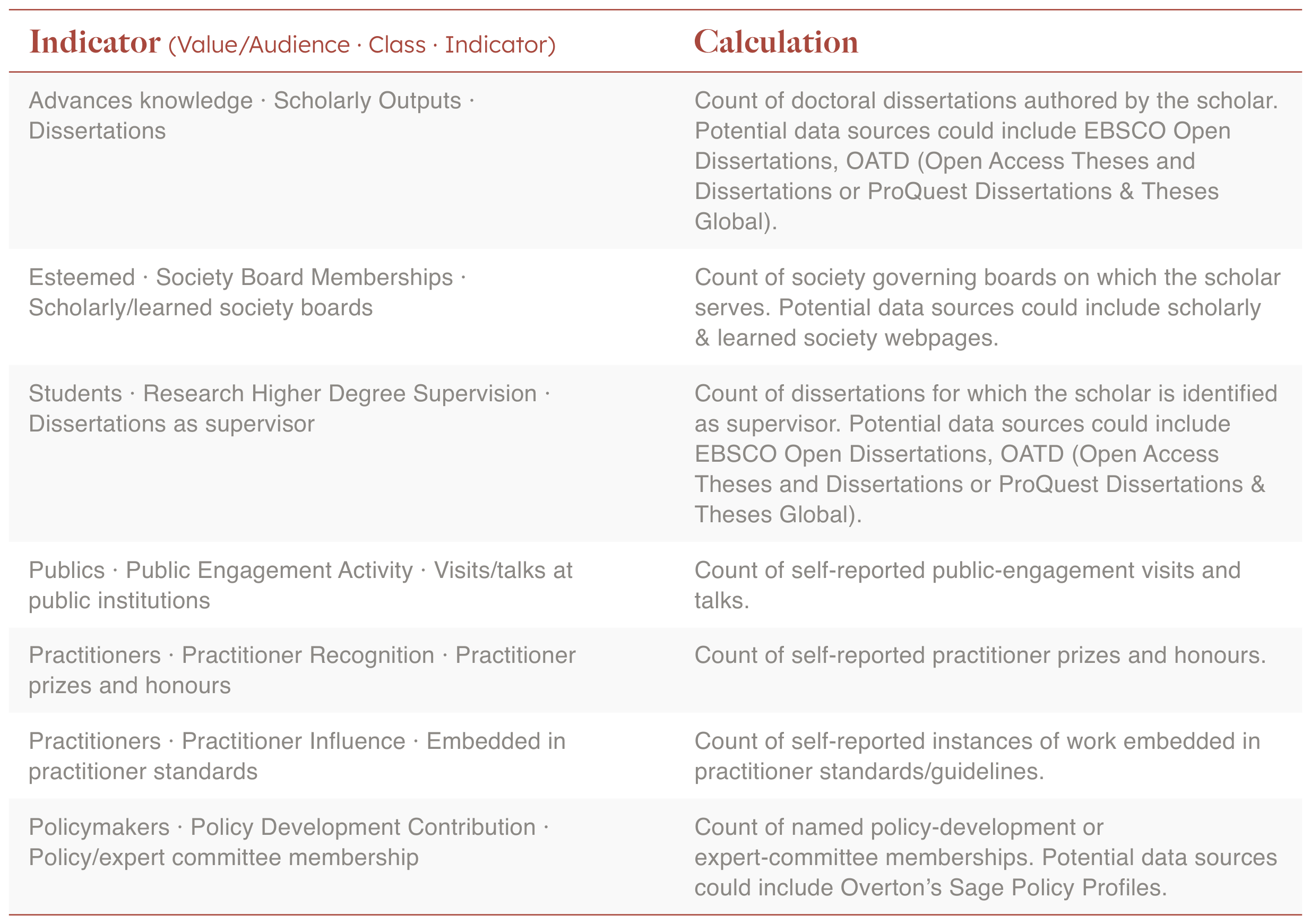
The VBSA was developed and initially tested in a university setting, hence the examples in this Handbook remain grounded in the higher education sector and its operational contexts. It is intended for everyone involved in evaluating A&H scholarship, including university leaders and their strategy teams; faculty deans; college or department heads; research group leaders; and the scholars whose work is being evaluated.
Although the VBSA was developed at a university, the questions it raises may also be relevant to research funders, public bodies supporting funded research, learned societies, private foundations and other persons and entities concerned with the fair evaluation of A&H scholarship and its impacts. We hope that these communities will engage critically with the approach and contribute to its further testing and refinement.
The Handbook is best read in sequence: the earlier sections set out the motivation for the VBSA and the data and methods behind it, while later sections describe how it was developed and how it can be applied. As familiarity with the array grows, we anticipate that readers will return to the sections most relevant to their own evaluative needs.
The following scenarios illustrate how diverse groups of users may use this Handbook.
University leaders and institutional strategists
University leaders and strategists may use the Handbook to develop a broader understanding of the contribution of A&H scholarship at institutional, faculty, or disciplinary levels and how quality research engages multiple levels dynamically. The array may support strategic reviews, institutional narratives, advocacy, resource planning, and the development of more inclusive evaluation policies.
These users may wish to:
- Identify dimensions of A&H contribution that are not visible through conventional publications and citation-based indicators
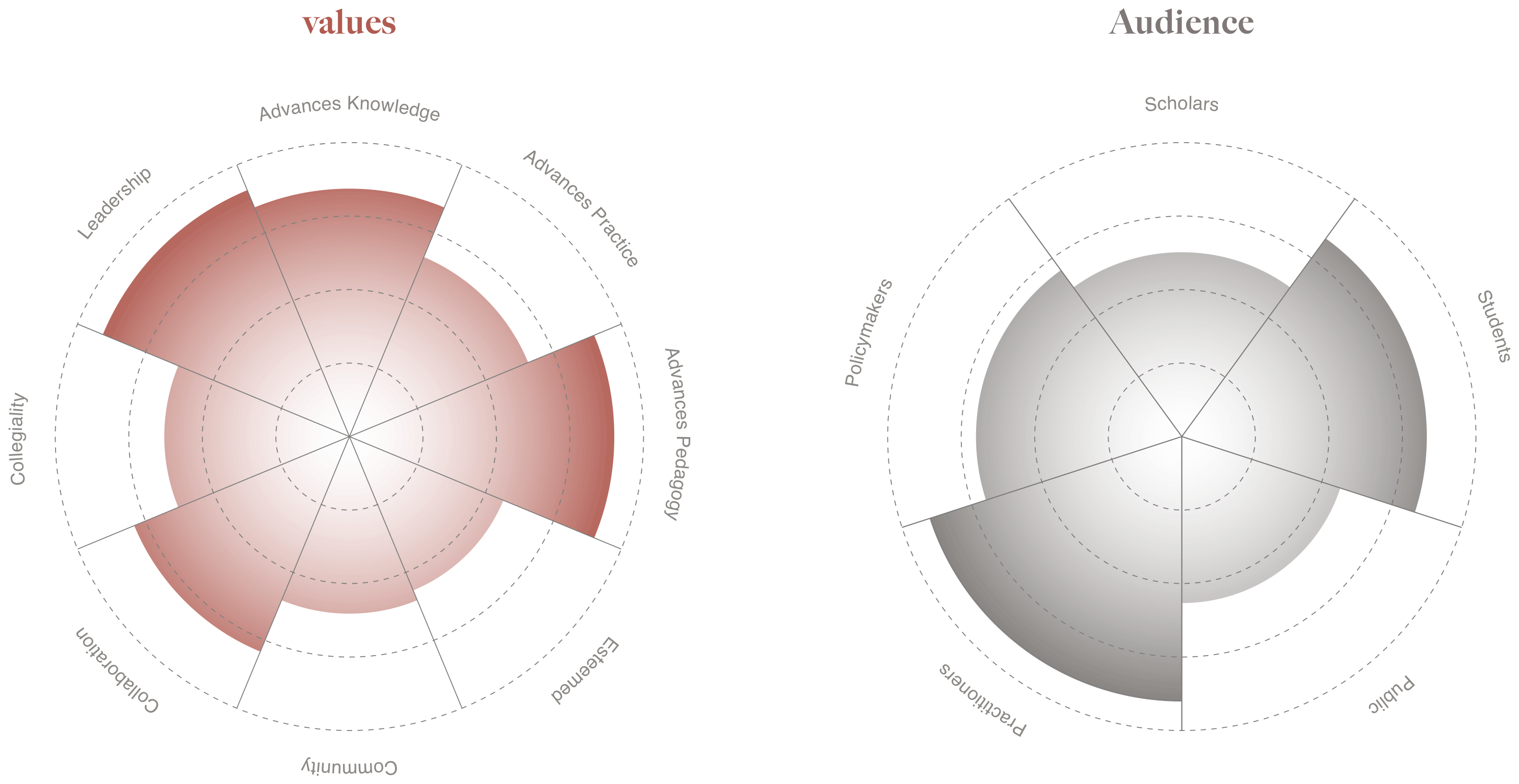
- Examine patterns of strength across different values and diverse audiences
- Review whether institutional systems capture the evidence required for fair evaluation
- Support institutional reporting and communication about the wider value of A&H scholarship, and
- Establish principles for the responsible use of indicators in assessment
“We need to be able to have that conversation about the relative strength of arts and humanities research compared to science, social science and we need to find a metric that we can use to do that.”
Vice Chancellor for Arts and Humanities, University of East Anglia
Deans, heads of departments and research leaders
Academic leaders may use the Handbook to support periodic reviews, research planning, staff development, and conversations about the contribution of academic units, research groups, or individual scholars. The array can help make visible different forms of contribution within a unit, and across units, including measuring the impact of scholarship, creative practice, pedagogy, collegiality, leadership, and engagement with audiences beyond academia.
These users may wish to:
- Agree which values and audiences are most relevant to the mission and disciplinary profile of the unit
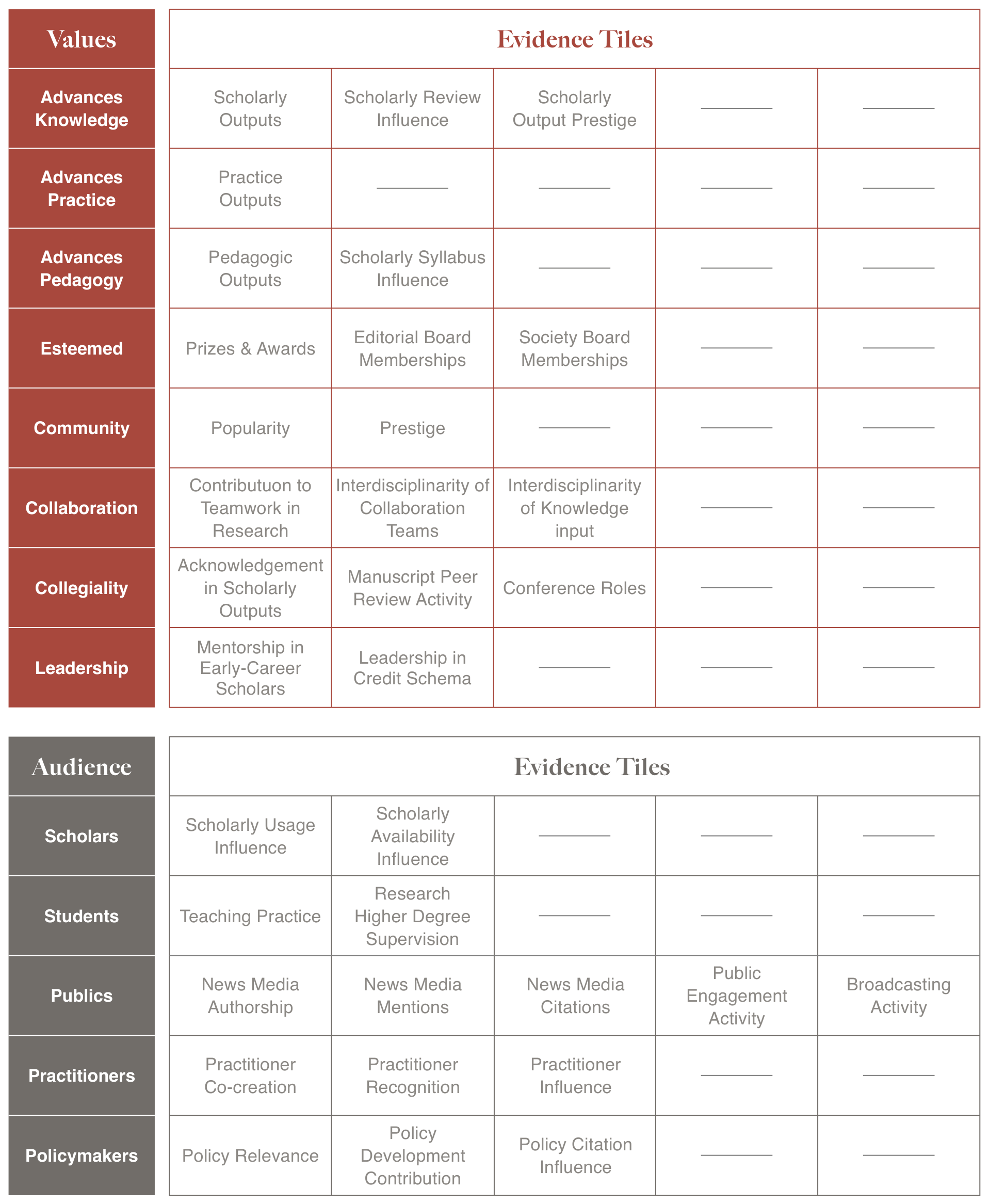
- Select a manageable set of evidence tiles for a particular review
- Recognise complementary forms of contribution across a department, a multi-disciplinary team, or research group
- Identify activities that are important but insufficiently documented under existing review parameters, and
- Use the resulting evidence to inform qualitative discussions and future planning
“You’re bringing extremely valuable data to any kind of assessment. I will reach for any and all evidence I can find to help me build a better case.”
Professor of Literature, Hong Kong Baptist University
Appointment, promotion, and performance-review panels
Panels responsible for appointment, promotion, or performance review may use the Handbook to broaden the range of evidence considered and to make evaluative expectations more transparent. It may be particularly helpful when conducting reviews where conventional indicators provide an incomplete or inaccurate account of the impact of books, creative outputs, teaching, public engagement, professional influence, or disciplinary service.
Panels may wish to:
- Agree upon relevant values and forms of evidence before the assessment begins
- Invite candidates to explain the values and audiences most relevant to their work
- Consider indicators alongside portfolios, narratives, and expert peer review
- Interpret evidence in relation to discipline, career stage, role, and opportunity, and
- Distinguish the absence of recorded evidence from the absence of contribution
“I can see it being useful for promotion applications and for writing a REF environment statement — to look at the array of types of engagement coming out of research.”
Professor of Theatre and Performance; Director of Research and Innovation in the School of Arts and Architecture, University of Kent
Individual scholars
Individual scholars may use the Handbook to reflect upon, organise, and communicate the breadth and impact of their scholarship beyond conventional metrics. It can provide effective guidance for preparing promotion or performance-review materials, developing an academic portfolio, planning future activity, or explaining contributions that are not currently well represented in research databases.
Scholars may wish to:
- Identify the values that best describe their scholarly contribution
- Consider the academic and non-academic audiences their work is intended to reach
- Select evidence tiles that support an account of those contributions
- Validate externally sourced information and supplement it with contextual or self-reported evidence, and
- Develop a narrative that explains the significance, development, and interrelationships of the evidence presented
“I like when I hear that I’m doing some good stuff. But I like even more to change that — that’s the opportunity for learning: if you hear precisely what you are doing wrong.”
Professor of Modern Languages, University of Birmingham, on the value of specific, constructive feedback in individual evaluation
Institutional research, library, and data teams
Institutional research and data offices, libraries, and research offices may use the Handbook to support the practical implementation of the VBSA. Their role may include identifying data sources, linking records, assessing data quality, documenting limitations, and presenting evidence in forms that support responsible and actionable interpretations conducive to effective decision-making in higher-education contexts.
These teams may wish to:
- Map existing institutional and external data to the relevant evidence tiles
- Assess the coverage, accessibility, and reliability of potential data sources
- Establish procedures for researcher validation and correction
- Record the provenance, time period, and limitations of each indicator
- Identify where institutional or self-reported information is required, and
- Develop profiles or dashboards that retain the connection between evidence, context, and narrative
“Some way of, for instance, a software package that could take a much more holistic view, the intersection of qualitative and quantitative data would be fantastic.”
Associate Dean of Research, Faculty of Arts and Humanities, University of East Anglia
Research funders, learned societies, and sector bodies
Research funders, learned societies, and sector bodies may use the Handbook as a basis for reviewing evaluation criteria, when consulting cross-disciplinary or transdisciplinary scholarly communities, and exploring more appropriate evidence of A&H contributions. The framework may also support programme evaluation or analysis at disciplinary, sectoral, or national levels.
These users may wish to:
- Examine whether existing criteria adequately recognises the diversity of A&H scholarship
- Work with cross-disciplinary or transdisciplinary scholarly communities to adapt the values, audiences, and evidence tiles to specific research contexts
- Pilot selected elements of the array before applying them more widely in learning, teaching, and research
- Identify systematic gaps and biases in available evidence, and
- Use aggregated findings to inform policy and system development
“One thing to be concerned about when it comes to arts and humanities is that different disciplines really are quite different.”
Professor of Applied Ethics, University of Leeds