Values
What A&H scholars recognise as constituting good scholarship.
Evidence tiles defined
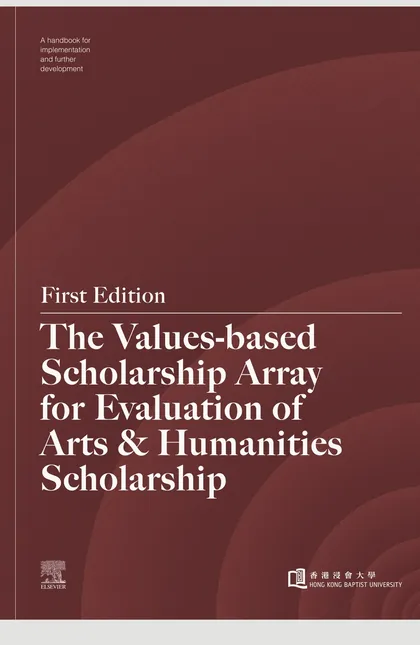
1st First Edition · A handbook for implementation and further development
An approach to evaluation of Arts and Humanities (A&H) scholarship that is rooted in the values of scholars and the audiences their work is intended to reach.


01 The framework
Arts and Humanities scholarship should be evaluated on terms that reflect its own values and audiences, not those borrowed from the sciences.
The Values-based Scholarship Array (VBSA) is the result of a collaboration between the Hong Kong Baptist University (HKBU) and Elsevier and offers an approach to evaluation of Arts and Humanities (A&H) scholarship that is rooted in the values of scholars and the audiences their work is intended to reach.
The VBSA emphasises the distinctive aspects of A&H scholarship that sets it apart from research in Science, Technology, Engineering, Mathematics and Medicine (STEMM) disciplines. It has been developed as an alternative approach to evaluation models that are more applicable to STEMM modes of knowledge production and utilisation.
We are sharing this approach for free use and adaptation, with a view to furthering our collective understanding of how to appropriately value the contributions of A&H scholars and their scholarship globally.
I am a scholar who advances knowledge and/or practice and/or pedagogy as an esteemed member of a community through collaboration, collegiality, and leadership. My scholarship is intended to impact other scholars, students, publics, practitioners and policymakers.
02 The array
VBSA turns each value and audience into a set of evidence tiles, which may be applicable to different individuals at different career stages and can be supported by qualitative evidence as well as quantitative indicators.
What A&H scholars recognise as constituting good scholarship.
Who the work is intended to reach — and be accountable to.
03 The array in full
The two tables below are the working heart of the framework. A hatched cell marks a place where the community has not yet agreed an indicator — those gaps are an invitation, not an omission.
04 In practice
Two of the profiles in the report, with the percentiles recorded for each scholar. Every figure below is the report's; the wording of each axis is the report's too.
Percentile among scholars in the same Subject within the supplied HKBU corpus. Category score = equal-weight mean percentile of available mapped indicators. Values use Handbook Table 1; audiences use Handbook Table 2 only.
05 How it was built
Before the array could be tested it needed a population. The pilot cohort was assembled through a multi-source process, deliberately weighted towards breadth across career stages and output types rather than towards the easiest data to find.
Two principles carried over from how the array was built: that evaluation should be more legitimate rather than merely more data-rich, and that evaluatees should retain agency over how their record is read.
Current academic staff lists from the Human Resources Office, filtered by primary affiliation in A&H-relevant departments and academies within FASS — including the Academy of Chinese, History, Religion and Philosophy; the Academy of Language and Culture; and the Academy of Geography, Sociology and International Studies — plus overlapping units in the School of Creative Arts.
The lists were matched against HKBU's Integrated Research Information and Management System (IRIMS, powered by Elsevier Pure) to identify researchers with A&H-classified outputs or self-reported interests in the target fields.
Departmental websites, scholars.hkbu.edu.hk profiles and direct input from academic advisors ensured inclusive coverage of practice-based, creative and interdisciplinary scholars who are under-represented in purely bibliometric sources.
English and Chinese names, current position and department, Scopus Author Identifier where available and manually validated, ORCID iD, and a proxy for career stage — first publication year, or years since the highest degree.
This curated roster enabled high-confidence linkage to external databases via persistent identifiers wherever possible, while name-based matching with manual review and institutional context was applied for sources without identifiers. The resulting linked dataset supports both granular individual profiles and responsible aggregation to departmental, faculty or institutional levels.3
06 Who made it
The VBSA offers an approach to the evaluation of Arts and Humanities scholarship that is rooted in the values of scholars and the audiences their work is intended to reach.
It was developed with, and reviewed by, scholars and evaluation specialists across the sector — because a framework for judging A&H scholarship has to be owned by the community it judges.
07 Contributors
Supporting organisations, contributing authors, reviewers and advisors — listed so that the framework carries names, not just institutions.
Supporting organisations
Contributing research analytics, data infrastructure and expertise.
Convening the array and anchoring it in institutional practice.

A global network of research universities, supporting wider testing of the array.
Contributing authors
Reviewers
Special thanks
08 Milestones & events
The framework is published as it develops, not after the fact.
Scoping the gap between A&H values and inherited evaluation practice.
CompletePresenting the array to the research evaluation community at RESSH 2026 in Firenze.
CompleteThe full Handbook, published openly for institutions and scholars.
In preparationPilots with implementing institutions, and refinement of the empty tiles.
Open09 Get in touch
Tell us about your institution, your evaluation context, or the values you are trying to make visible. We will point you to the right part of the Handbook — or to the team that can help you adapt it.
03 · The array in full
Tell us what is missing, or what does not fit your discipline. Comments are read by the VBSA team; they are not published.